
Hormone Therapy Without Workup Is Surrender
If a clinician prescribed you hormone replacement without first measuring the system that regulates the hormone, they didn't treat you. They sold you a product. And the system that suppressed your number is still suppressing it while you pay every month to override the symptom.
Replacement Overrides the Output. It Does Not Change the Cause.
Replacement therapy is exogenous override of a regulatory output. The body had a reason for the output. Replacement assumes the reason is irrelevant.
The dominant model in performance medicine right now is one-variable thinking applied to a multi-variable regulatory system. Low T, prescribe T. Low T3, prescribe T3. Dysregulated cortisol, prescribe an adaptogen or a hydrocortisone tablet. Each prescription treats one number. The body produced that number as part of a coordinated regulatory response. Treating it in isolation collapses the conversation.
Replacement therapy without an upstream workup is not medicine. It is product.
The HPA axis is that conversation. Cortisol regulation governs sex hormone production, thyroid conversion, recovery hormones, and inflammatory tone. When the axis is loaded by chronic training stress, undersleep, undernutrition, psychological load, or environmental input, the body suppresses downstream output on purpose. That suppression is not pathology. It's adaptive regulation. The body is protecting itself from making hormones it cannot afford to make.
Replacement therapy overrides that protection. It tells the body the regulation is wrong and floods the system with exogenous hormone the upstream context does not support. The number moves. The reason the number was low does not.
This is why men on TRT often feel different but not actually better six months in. The number moved. The HPA axis is still loaded. The recovery problem, the sleep problem, the inflammation problem, the cognitive problem are still there. Because the upstream regulator was never opened.
The clinical posture: replacement is a tool, not an answer. It belongs in the protocol after the upstream regulator has been mapped, the load has been identified, and the input pattern that drove the suppression has been changed. Replacement applied first, replacement applied alone, replacement applied as the default is surrender disguised as treatment.
The number was the body's way of telling on its environment. Replacing the number does not change the environment. It only silences the report.
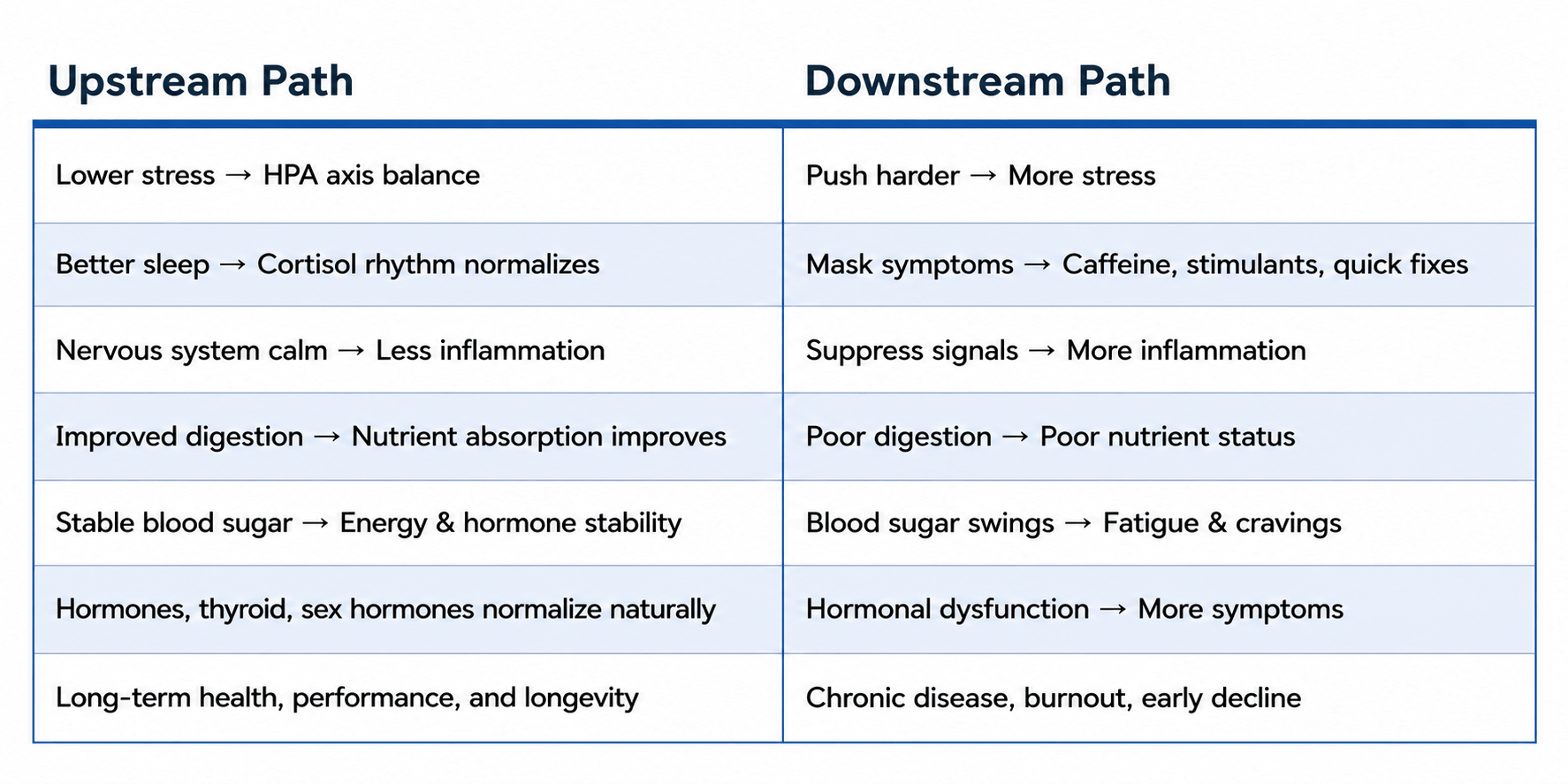
How the body actually regulates the hormonal conversation, and what an upstream workup looks like in practice, is in this Monday's article on the blog. This Brief is the argument for why you should run it.
Five Questions to Ask Before You Accept the Prescription
If you have been handed a hormone replacement prescription, the question is not whether it works. The question is what was measured before it was prescribed.
The five questions to ask any clinician before accepting replacement therapy:
Have you measured my diurnal cortisol curve?
Have you measured DHEA-S and the DHEA-to-cortisol ratio?
Have you measured free testosterone with SHBG, free T3, reverse T3, and TSH together?
Have you mapped my recovery, sleep, training load, and inflammatory tone alongside the labs?
If the upstream regulator is loaded, what's the input-change plan before we override the output?
If the clinician answers all five with specifics, you are with a provider who understands the system. If they cannot answer them, you have a provider running a one-variable model on a multi-variable body. That's the moment to pause the prescription.
The threshold that matters: if you're currently on replacement and your recovery, sleep, body composition, or cognitive clarity have not measurably improved in 90 days, the prescription is treating the receipt while the upstream regulator continues to suppress. That's the data gap that needs to be filled before the next refill.
THIS WEEK
Pull your most recent hormone panel. For every result that came back "in range," ask one question: do I know what input in my life is currently keeping that number where it is?
If you can't answer for testosterone, cortisol, or thyroid, your hormone panel is a polaroid. Not a map.
The Conversation Your Prescription Replaced
If you've been handed a prescription before you were handed a workup, the conversation hasn't happened yet. The Performance Gap Diagnostic is where it starts. Learn more and GET STARTED HERE.
P.S. The full four-pillar walkthrough, including the upstream HPA model that should be measured before any replacement decision, is the Performance Gap Webinar, Saturday May 30 at 10am CT. Register here
Key Takeaways
Hormone replacement without an upstream HPA workup is product fulfillment, not medicine. The clinician treated the receipt while the regulator stayed closed.
A low hormone number is the body's report on its environment. Overriding the number does not change the environment. It only silences the report.
Replacement is a tool, not an answer. It belongs in the protocol after the upstream regulator has been mapped and the load has been changed, not as the default first move.