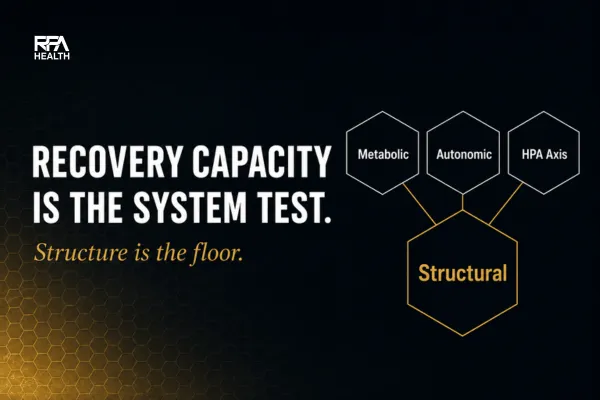
Recovery Capacity Is the System Test. Structure Is the Floor.
The patient was disciplined. Training four days a week. Sleeping seven hours. Eating clean. Not recovering.
Adding more structure did not help. It accelerated the problem.
This is the pattern. It doesn't look like a problem from the outside. The output is consistent. The protocol is dialed. The labs come back unremarkable. And the system, quietly, is compounding deficit underneath it.
Recovery is not rest. It's active physiology. And when the system that produces recovery is itself loaded, more input does not produce more adaptation. It produces more debt.
Disease is the endpoint. Decline is the runway. The Performance Gap is what we measure on the runway.
Recovery is downstream of four systems
Performance is the last thing to drop. By the time output falls, the recovery system has been working around the load for months.
Recovery is not one system. It's the integration of four:
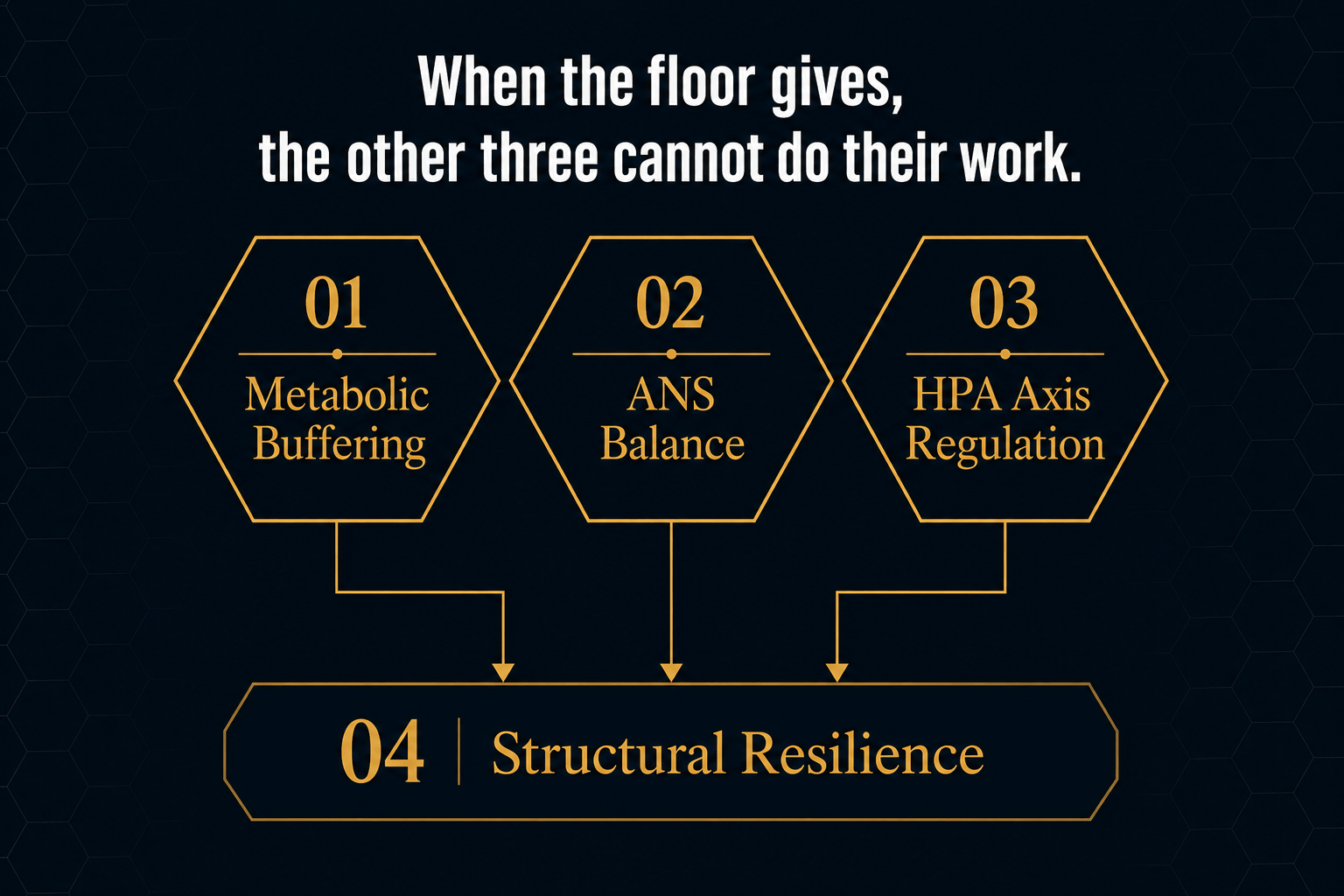
Metabolic Buffering. Substrate availability, mitochondrial density, the system's capacity to clear inflammatory load without disrupting function.
ANS Balance. The autonomic nervous system's ability to oscillate. Drive on for output. Drive off for restoration.
HPA Axis Regulation. The diurnal cortisol arc that times when the body restores and when it produces.
Structural Resilience. Connective tissue, neuromuscular recovery rate, movement tolerance. The floor under the other three.
When any one of them is loaded, the others compensate. When two or three are loaded, the system runs on whichever pillar still has capacity. The output looks stable until it's not.
Disease is the endpoint. Decline is the runway. The Performance Gap is what we measure on the runway.
The site of pain is rarely where the problem is. The site of pain is the receipt.
Structural resilience is the floor
The other three pillars get most of the conversation. Metabolic. Hormonal. Autonomic. Those are the pillars that move the needles on a panel.
Structure is the pillar that decides whether any of the other three can do their work.
Here's what that means clinically. If the structural system is compensating, the autonomic system stays partially activated. Pain is a sympathetic driver. Asymmetric load is a sympathetic driver. Inefficient movement increases the energetic cost of every task, which loads metabolic buffering. Chronic structural compensation pulls the HPA axis into a low-grade activation pattern. The patient interprets the result as fatigue, poor sleep, or stress. The upstream is structural.
The site of pain is rarely where the problem is. The site of pain is the receipt.
Structural resilience is not flexibility. It's not strength. It's the capacity of the tissue, the joint, and the nervous system that controls them to absorb load without compensating elsewhere. When that capacity is exceeded, the body picks up the cost somewhere downstream.
What a recovery deficit actually looks like
The diagnostic problem with recovery deficit is that it does not announce itself. Output is the last marker to move. Several other markers move first, and most patients are reading them as motivation problems.
The early signal stack:
HRV trend declining over two or more weeks. Not single-day variability. The trend line.
Resting heart rate creeping five beats or more above baseline. Without a clear acute cause.
Sleep efficiency below 85 percent despite adequate duration. The hours are there. The architecture is not.
Perceived exertion rising at the same training load. The math is the same. The cost is higher.
Cognitive latency. Decisions take slightly longer. Recall is slower. The bandwidth narrows.
If three or more of these are present, the system is in deficit. The output number is the last domino. By the time it falls, the system has been compensating for months.
Overreaching is not overtraining
The clinical distinction matters because the interventions are different.
Functional overreaching is a temporary performance decline from accumulated load. Fully reversible in one to two weeks of appropriate recovery. The system is loaded but intact. The audit picks up early markers. The fix is structured downregulation.
Non-functional overreaching sits between. Performance decline lasts weeks to a few months. Hormonal and autonomic markers shift. The fix takes longer and requires reducing both load and input variability.
Overtraining syndrome is a clinical diagnosis. Systemic dysfunction across hormonal, immunological, and neurological systems. Months to resolve. Not a programming issue. A physiology issue.
Most high performers I see are in functional or non-functional overreaching and treating it as a motivation problem. They add more structure. They tighten the protocol. They wake up earlier. The system, already loaded, takes the additional input as additional debt.
You cannot outwork a recovery deficit. The answer is not more. The answer is accurate.
What a recovery and structural audit measures
A recovery audit is built around the question. The question is not whether the patient is "fine." The question is whether the system has the capacity to recover into the output being asked of it.
Sleep architecture, seven nights minimum. Slow-wave and REM, not just duration. Wake-after-sleep-onset trends.
HRV baseline, three-week trend. Single readings are noise. Trends are signal.
Resting heart rate trend, same window.
Hormonal context. Diurnal cortisol curve, DHEA-S, free testosterone with SHBG, free T3 with reverse T3. Recovery is downstream of these.
Inflammatory load. hs-CRP trending. Single-point CRP is not enough.
Structural load tolerance. Movement tolerance under standardized testing. Joint-by-joint capacity. Asymmetry that is being compensated rather than corrected. Connective tissue recovery rate by region.
Training and work load history. Volume, intensity distribution, recovery days per block. Not just what the patient is doing, but what the system has been carrying.
This is not a "more is better" audit. It's a panel and assessment built around the question. The question is whether the regulatory environment, the structural substrate, and the recovery system have the capacity to support the output, or whether they are quietly subsidizing it.
You cannot demand more output from a system that has not recovered. And the recovery system itself is downstream of four pillars working together. Metabolic. Autonomic. Hormonal. Structural.
When the structural floor gives, the other three cannot do their work. When the structure is intact, the audit gets cleaner and the interventions move faster.
If your panels keep coming back "in range" and the picture still does not match how the system feels under load, the model you are being measured against may simply not be answering the question you are asking.
[Take the Performance Gap Diagnostic — $275]
P.S. I'm also running a live training this Saturday May 30 at 10am Central that walks the four-pillar map in one sitting. Registration is open. If the timing works, the link is here. If not, the diagnostic and this article cover the model.
Key Takeaways
Recovery is not rest. It is active physiology. When the system that produces recovery is itself loaded, more input does not produce more adaptation. It produces more debt.
Recovery is downstream of four pillars working together. Metabolic Buffering, ANS Balance, HPA Axis Regulation, and Structural Resilience. They do not work in isolation. When one is loaded, the others compensate until the compensation runs out.
Structural resilience is the floor. The other three pillars get the panel attention. Structure decides whether they can do their work. Chronic structural compensation keeps the autonomic system partially activated, raises the energetic cost of every task, and pulls the HPA axis into low-grade activation. The site of pain is the receipt, not the problem.
Output is the last marker to drop. Several early signals move first and most patients misread them as motivation problems: HRV trend declining over two-plus weeks, resting heart rate creeping above baseline, sleep efficiency under 85% despite adequate hours, perceived exertion rising at the same load, cognitive latency. Three or more present means the system is already in deficit.
Overreaching is not overtraining. Three distinct clinical states with different interventions. Functional overreaching reverses in one to two weeks. Non-functional overreaching takes weeks to months. Overtraining syndrome is a clinical diagnosis with systemic dysfunction that takes months to resolve. Most high performers are in the first two and treating it as a discipline problem, which loads the system further.
You cannot outwork a recovery deficit. The answer is not more. The answer is accurate.
A real recovery audit is built around the question. Sleep architecture (seven nights), HRV and resting HR trends (three weeks), hormonal context (diurnal cortisol, free T with SHBG, free T3 with reverse T3), inflammatory load (hs-CRP trending), structural load tolerance (movement testing, joint-by-joint capacity, asymmetry), and load history. Not more-is-better. Built around whether the system has capacity to recover into the output being asked of it.
Disease vs. Decline, restated for this pillar. The standard panel was built to find disease. The patient is asking about decline. Decline is the runway. The Performance Gap is what we measure on the runway.
1. Plews DJ et al. "Heart rate variability in elite triathletes." Eur J Appl Physiol. 2013 — HRV as a marker of accumulated training load and recovery state.
2. Kellmann M. "Preventing overtraining in athletes in high-intensity sports and stress/recovery monitoring." Scand J Med Sci Sports. 2010 — distinguishing functional overreaching from non-functional overreaching from overtraining syndrome.
3. Halson SL. "Sleep in elite athletes and nutritional interventions to enhance sleep." Sports Med. 2014 — sleep architecture and recovery.
4. Meeusen R et al. "Prevention, diagnosis, and treatment of the overtraining syndrome." Joint Consensus Statement, ECSS/ACSM. 2013 — the clinical distinction matters for treatment direction.
5. Cook G, Burton L et al. "Functional Movement Screen and injury prediction." Citations supporting movement tolerance as predictive of structural load capacity.