
The Mitochondria Problem Nobody Is Testing For
The Workup Did Not Measure the Engine
If your output is degrading, your recovery is stretching, and the workup came back clean, the workup did not measure the engine. It measured the fuel sitting next to it.
The mitochondria are the engine. They were not tested.
The Engine Lives Inside the Cell
A standard panel reads glucose, B12, ferritin, TSH, free T4, lipids, CBC. Those are inputs and downstream markers. They tell you the fuel and the regulatory signals are present in circulation. They do not tell you whether the cell is converting them into ATP.
That conversion happens inside the mitochondria, in the Krebs cycle and the electron transport chain. Every cell that demands sustained output, every muscle fiber, every neuron, every cardiac cell, depends on mitochondrial throughput. When mitochondrial output drops, the fuel sits unused. The blood looks fine because the fuel is still there. The cell is laboring because the engine is not turning it into work.
Your standard panel measures what is in the blood. Your mitochondria are what turns it into energy. The conversion was never tested.
This is what produces the pattern the high-output adult knows by feel and the panel refuses to confirm. Fatigue that does not respond to sleep. Recovery from a session that used to be routine now stretches across multiple days. Exercise intolerance, where heart rate spikes earlier and clears slower. Brain fog in the afternoon despite adequate sleep and food. Body composition drift while training has not changed. Each of these is a signal from the engine. None of them shows up on a fuel-side panel because the panel is not looking at production.
The Organic Acids Test, the OAT panel, is the test that does. It measures urinary metabolites of the Krebs cycle and fatty acid oxidation. When the cycle stalls at a specific step, the intermediate before that step backs up and spills into the urine. The pattern tells you where the block is, and the block tells you which cofactor is missing or which upstream system is compromised. Citrate and isocitrate elevations point to one part of the cycle. Succinate and fumarate elevations point to another. The map is specific.
A full tank does not prove a working engine.
The clinical posture is direct. If a high-output adult presents with degrading output and a clean panel, the panel has answered a question that was not asked. The question is not what is in the blood. The question is what the cell is producing. A serum B12 inside the reference range tells you the fuel is available. A methylmalonic acid elevation tells you the cell cannot use it. Those two results come from the same patient on the same day, and they tell a completely different story about what is happening inside the engine.
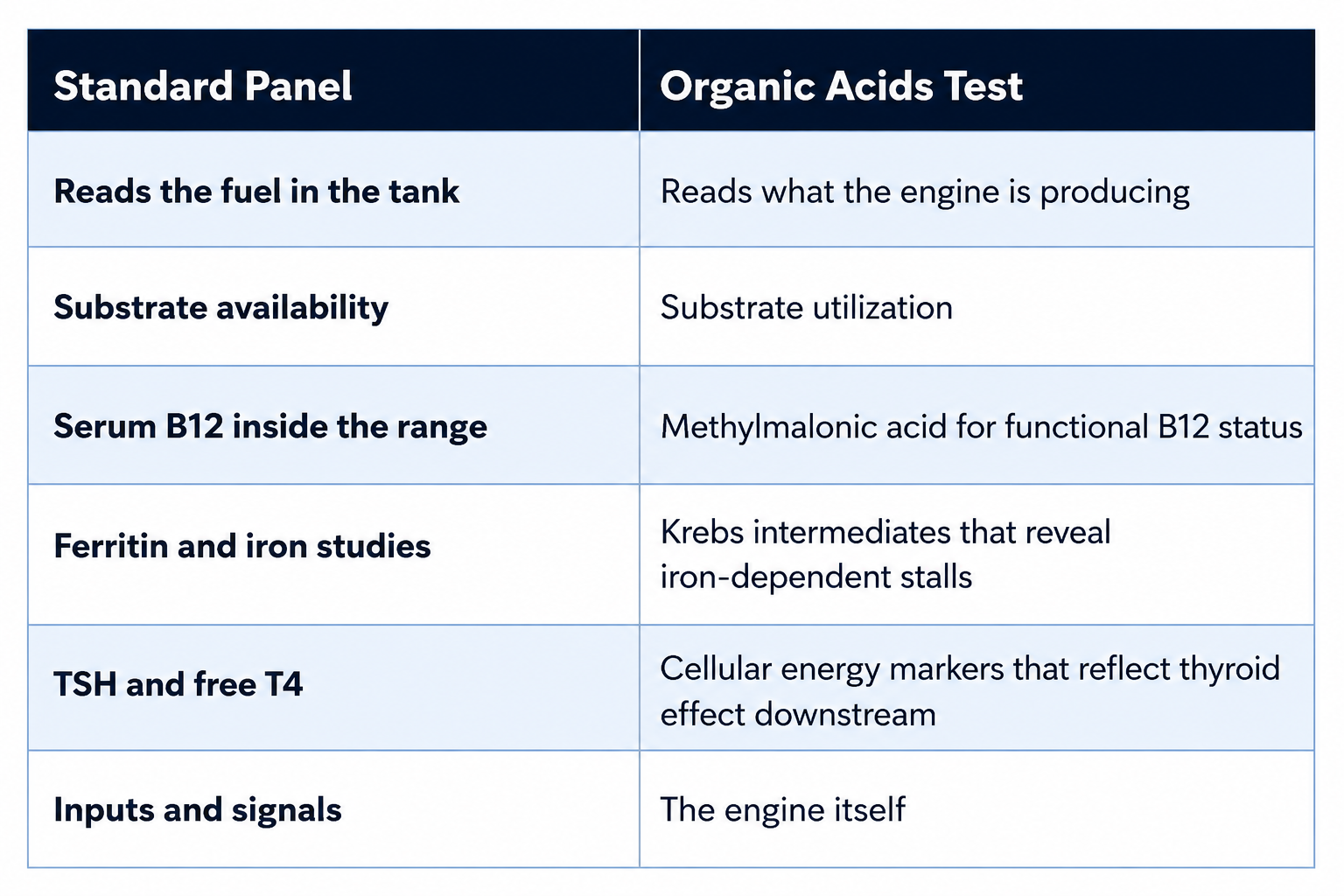
The Five OAT Markers That Map the Stall
If you fit the pattern, degrading output with a clean panel, the data you are missing is at the cellular conversion level. Five OAT markers do most of the diagnostic work for the high-output adult, and any clinician running mitochondrial assessment should be able to name them.
Methylmalonic acid.
An elevation flags functional B12 deficiency even when serum B12 is inside the reference range. B12 is a required cofactor at a specific step in the Krebs cycle and in fatty acid oxidation. Functional deficiency stalls both.
Xanthurenate and kynurenate.
Elevations flag B6 insufficiency at the cellular level. B6 is required for neurotransmitter synthesis and for amino acid handling that feeds the Krebs cycle. Low B6 at the cell shows up in the urine before it shows up in symptom severity.
Adipate, suberate, and ethylmalonate.
Elevations flag impaired fatty acid oxidation. Fatty acid oxidation is the dominant energy pathway at moderate aerobic intensities. When this stalls, the body cannot run on fat efficiently, glycogen drains faster, and recovery between sessions lengthens.
3-hydroxy-3-methylglutarate.
Elevation flags compromised CoQ10 status. CoQ10 is the central electron carrier in the electron transport chain. Without sufficient CoQ10, ATP production drops regardless of how much fuel is available.
8-hydroxy-2-deoxyguanosine (8-OHdG).
Elevation flags oxidative stress damaging mitochondrial DNA. This is the marker that tells you the engine is not only running poorly, it is being damaged by the conditions it is running under.
The self-assessment frame, before any test: fatigue that does not respond to sleep, slow recovery from previously routine sessions, exercise intolerance with delayed heart rate clearance, afternoon brain fog despite stable sleep and food, body composition drift despite consistent training. Three or more out of five and the standard panel is not the right test for the question your body is asking.
The question to ask any clinician you are working with: "Have you measured my organic acid panel, specifically the Krebs cycle intermediates and the B-vitamin functional markers, to assess mitochondrial output and not just substrate availability?" If they cannot answer with the specific markers, the workup has not measured the engine.
The threshold that matters: if you meet three or more of the symptom criteria and have not run an OAT panel, the data gap is at the conversion level, not the input level. Filling the input side with more supplements, more food, more sleep, while leaving the engine unmeasured, is treating a problem you have not yet diagnosed.
THIS WEEK
Track your morning resting heart rate for seven days, taken before you get out of bed. Then walk one flight of stairs at moderate pace and time how long it takes to return to within five beats of resting.
A healthy engine clears that recovery in under sixty seconds. If your morning resting rate trends upward week over week despite consistent sleep and unchanged training, or stair recovery stretches past ninety seconds, the engine is laboring.
That is the mitochondrial signal a fuel-side panel does not catch. It tells you whether the question worth running an OAT panel for is already on the table.
The Test You Have Not Been Offered
If you have done the workup, gotten the clean result, and the engine still feels like it is laboring, the missing test is upstream of the panel that was run. The Performance Gap Diagnostic begins with the right panel for the question, not the conventional one. Start the conversation at the engine: The Performance Gap Diagnostic.
P.S. The full four-pillar walkthrough, including how mitochondrial output sits underneath the other three pillars, is the Performance Gap Webinar, Saturday May 30 at 10am CT. Register here.
— Dr. Josh
Key Takeaways
• The standard panel reads the fuel in the tank. The mitochondria determine whether that fuel becomes work. A clean panel and degrading output are not a contradiction. They are two different questions answered by two different tests.
• The Organic Acids Test reads the engine directly. Five markers, methylmalonic acid, xanthurenate, adipate, 3-hydroxy-3-methylglutarate, and 8-OHdG, map the exact step where the cycle is stalling and the cofactor or stressor responsible for it.
• If the symptom pattern is mitochondrial and the workup is not, the data gap is at the conversion level, not the input level. Adding more fuel to an engine that cannot burn it is treating a problem that has not yet been diagnosed.