
Your Hydration Mix Is Solving the Wrong Problem
What electrolytes are actually for, and why the sodium number on the label is the wrong thing to read.
The Number on the Packet Is a Sales Decision
They keep landing on my desk. Hydration sticks, electrolyte packets, the powders everyone is stirring into a water bottle. Most carry 700, 800, sometimes over 1,000 milligrams of sodium per serving. The big number is the selling point. It is the wrong thing to read.
What Your Muscles Actually Spend When They Fire
There is a movement right now that says the fix is simple. Add more salt. Drink it daily. More is better. I am not against sodium. I use these tools in my own training and with the people I work with. But the sodium-maximalist version of this trend misreads what these products are for.
Start with the word on the label. Hydration is a water-balance event. If you are genuinely fluid-depleted, you need water and the sodium that helps you hold it. That is not the mechanism you are reaching for mid-session. The real job is sustained nerve and muscle depolarization. Keeping excitable tissue firing under load.8
Firing is a team event. It is not a sodium event.
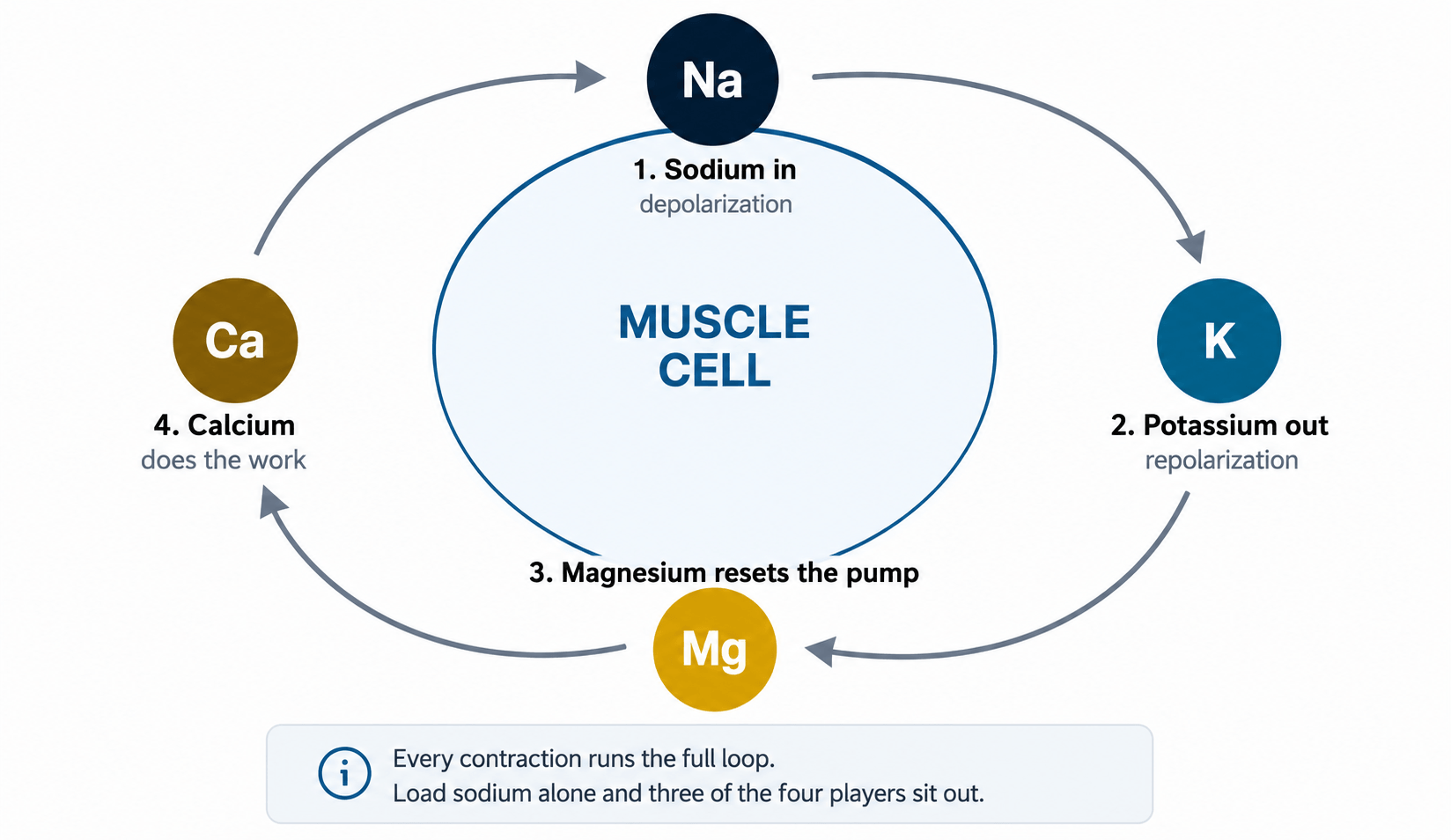
Every contraction and every nerve impulse spends a gradient. Sodium sits high outside the cell and low inside. When the cell fires, sodium rushes in. That is depolarization. Potassium moves out to reset the charge. That is repolarization. Then the sodium-potassium pump pushes both ions back into place, running on magnesium-bound ATP,7 while calcium couples the electrical signal to the contraction itself.
Sodium in. Potassium out. Magnesium runs the reset. Calcium does the work. A mix that delivers heavy sodium and a trace of the rest loads one player and benches the team. That is not full-cycle support. That is a single note played loud.
You Are Feeding the Shortage You Do Not Have
Here is the part the marketing skips. Most people are not short on sodium. Federal dietary data put average intake among U.S. adults near 3,400 milligrams a day, well above the recommended ceiling,12 while potassium is flagged as a nutrient most of the population under-consumes.4 The shortage runs the opposite direction from the packet.
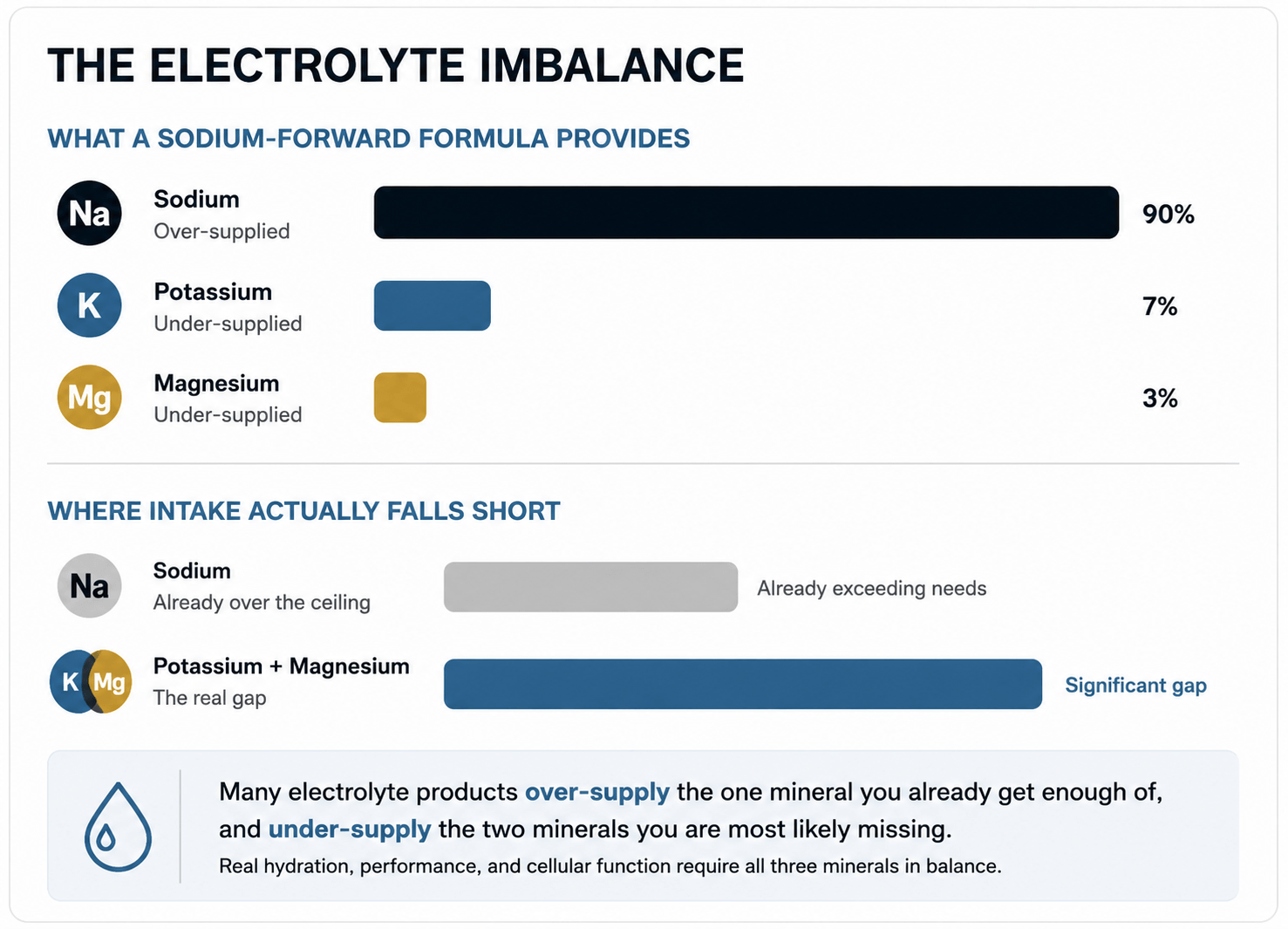
So the sodium-forward mix over-supplies what you already overshoot and shorts the two you are most likely missing. You are not under-salted. You are over-sold. The big number feels like more. Physiologically, it is often more of the wrong thing.
How to Read an Electrolyte Label Like a Clinician
Context decides the dose. The same product is right for one physiology and wrong for another, and the label treats everyone like the athlete in the heat. Sweat sodium losses vary widely between people, running roughly 20 to 100 millimoles per liter, which is about half a gram to over two grams of sodium per liter of sweat.56 An athlete losing one to two liters an hour at the salty end of that range has earned aggressive replacement. The dose is justified by the demand.
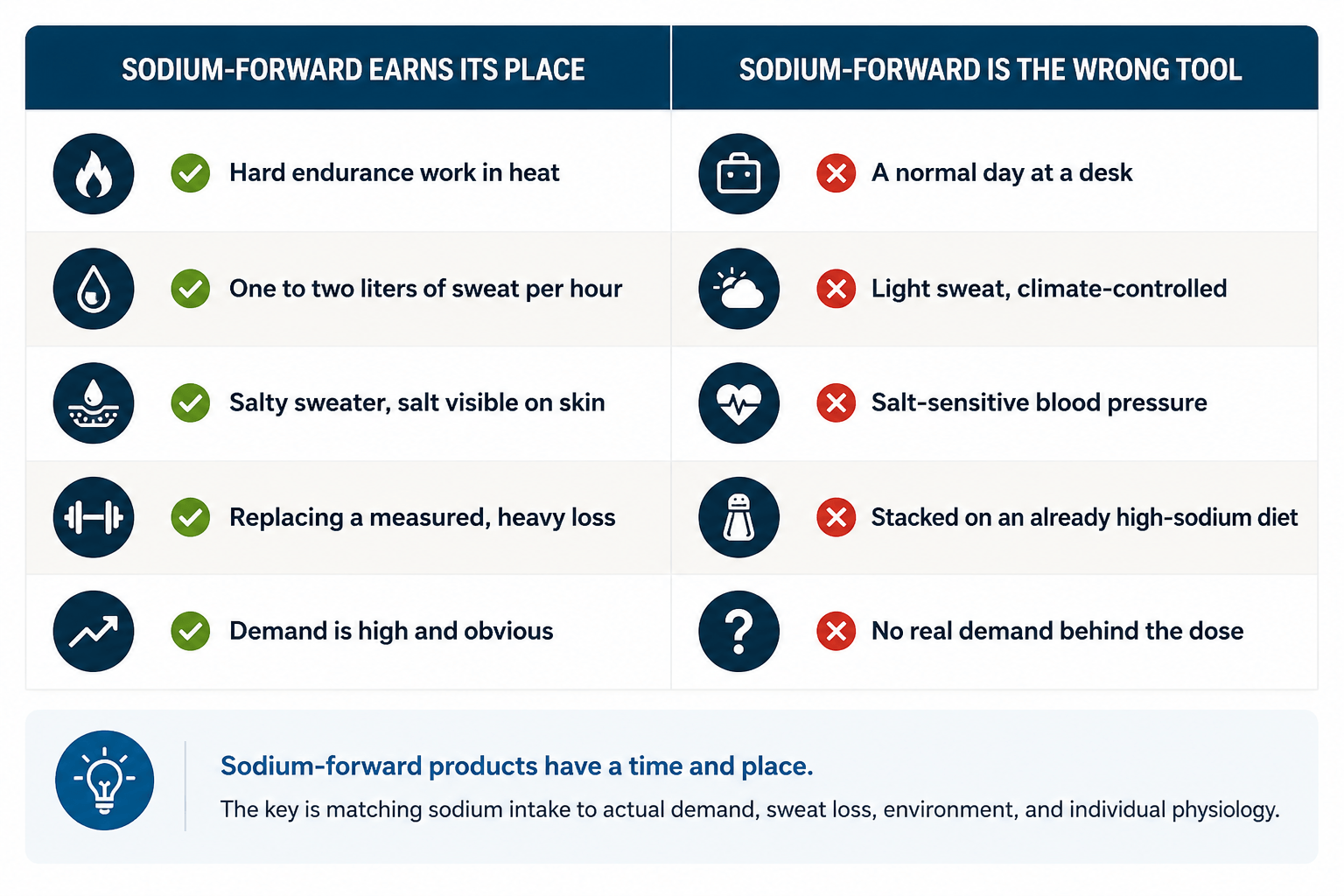
For the reader whose blood pressure is salt-sensitive, or whose kidneys or heart make sodium a clinical variable rather than a preference, an 800-milligram packet stacked on a high-sodium diet is not support. It is a quiet, compounding load.9If that is you, the packet on your counter is a question worth bringing to the clinician who manages that condition.
For everyone else, stop reading the sodium number alone. Read the ratio. A product built for depolarization carries potassium in a meaningful amount,3includes magnesium for the pump that resets every contraction, and does not try to win on sodium alone. Then match the tool to the demand. Hard sweat in heat earns the high-sodium load. A normal day does not.
THIS WEEK
Pull every hydration product in your cabinet. Find the sodium number, then find the potassium number on the same label, and put them side by side as a ratio. Notice how many are sodium with almost nothing across from it. That spread tells you whether you bought depolarization support or salt with branding. If potassium and magnesium are not on the label at all, you have your answer.
The Mineral Was Never the Question
If you cannot tell me the potassium-to-sodium ratio in the packet you drank this morning, you do not know what you took. You only know it was salty.
Key Takeaways
These products are not about water. The job is sustained nerve and muscle depolarization, and that runs on sodium, potassium, magnesium, and calcium together, not sodium alone.
Most people already over-consume sodium and under-consume potassium, so a sodium-heavy mix supplies what you have and shorts what you are missing.
The right dose is set by demand. Hard sweat in heat earns a high-sodium load. A normal day does not.
References
1) CDC.About Sodium and Health.cdc.gov/salt/about
2) American Heart Association.How Much Sodium Should I Eat Per Day?heart.org
3) NASEM.Dietary Reference Intakes for Sodium and Potassium(2019).nationalacademies.org
4) Potassium Intake of the U.S. Population (NHANES); 2020–2025 Dietary Guidelines for Americans.ncbi.nlm.nih.gov
5) Sawka MN, et al. ACSM Position Stand: Exercise and Fluid Replacement.Med Sci Sports Exerc.2007;39(2):377–390.
6) McDermott BP, et al. NATA Position Statement: Fluid Replacement for the Physically Active.J Athl Train.2017;52(9):877–895.
7) de Baaij JHF, et al. Magnesium in man.Physiol Rev.2015;95(1):1–46.
8) Hall JE, Hall ME.Guyton and Hall Textbook of Medical Physiology.Membrane and action potentials; Na/K-ATPase.
9) KDIGO (CKD); AHA/ACC/HFSA Heart Failure Guideline. Dietary sodium restriction in CKD and heart failure.
Educational content. Published population ranges, not individual medical advice.