
The Four Systems That Control Performance
THE OUTPUT PROBLEM STANDARD MEDICINE CAN'T SEE
Your standard panel came back normal. Your output is not normal. That gap has a name. It has four parts. And none of them are on your lab report.
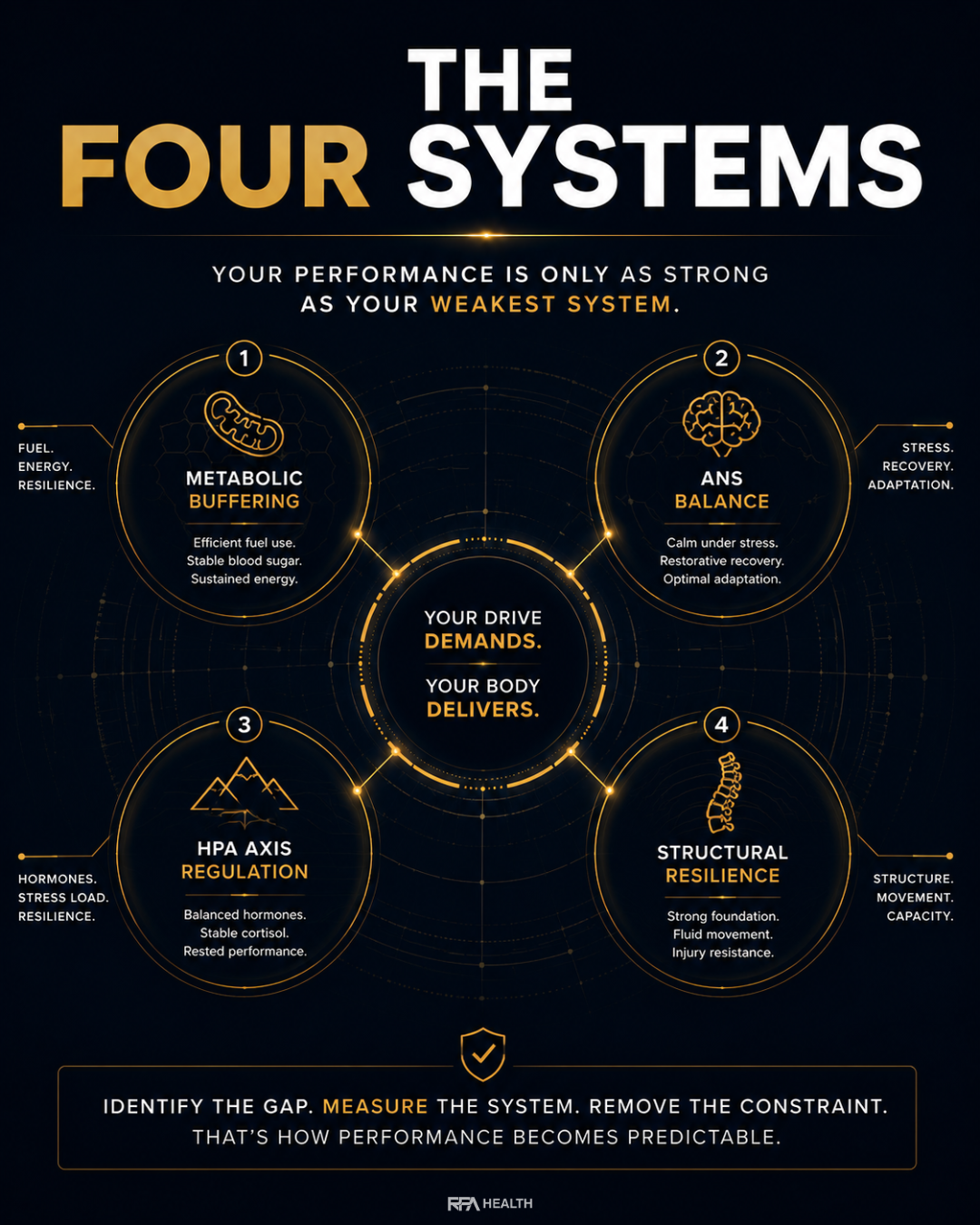
THE FOUR SYSTEMS RUNNING YOUR PERFORMANCE RIGHT NOW
Performance isn't produced by one system. It's the output of four distinct physiological systems operating in coordination. When one underperforms, it places load on the others. When two or three are dysregulated simultaneously, the compounding effect is what most high performers describe as 'feeling off.' Functional but not sharp. Working but not recovered. Moving but not performing.
Metabolic Buffering. This system governs how efficiently your cells produce energy, how stable your blood glucose stays under demand, and how much low-grade systemic inflammation is running in the background. When metabolic buffering is compromised, the first signal is performance degradation before any standard metabolic panel shows an abnormal value. Energy production falters before the lab catches it.
ANS Balance. The autonomic nervous system is the regulatory layer beneath conscious control. It governs heart rate variability, sleep architecture, recovery rate between training or work sessions, and how fast the system returns to baseline after stress exposure. When sympathetic dominance becomes the default state, recovery suffers first. Drive comes next. The clinical read is 'burnout drift': a progressive flattening of output that occurs while every biomarker reads within range.
HPA Axis Regulation. The hypothalamic-pituitary-adrenal axis controls cortisol, and cortisol controls almost everything downstream. Testosterone, DHEA, and thyroid function all run in relationship to cortisol's daily rhythm. When that rhythm drifts, the downstream effects are measurable but not catastrophic enough to flag on a standard panel. The category is drift, not deficiency. Standard endocrine panels were designed to catch deficiency. Drift is where most high performers have been living for years.
Structural Resilience. This system isn't about pain. It's about load capacity. Whether the body absorbs force and transfers it efficiently, or compensates by redistributing load onto structures not designed to carry it long-term. Compensation patterns develop gradually, below the threshold of pain, and become the operating baseline. When that baseline is disrupted, the pain site is rarely the problem site. The structure that failed is the one that had been compensating for the real restriction.
Not sick. Not optimal. Not catching up
The standard panel was designed to find disease. These four systems exist in the space between disease and optimal function.
That space has a name: The Performance Gap.
WHY NONE OF THIS SHOWS ON A STANDARD PANEL
The standard panel is a disease-detection instrument. It was engineered to identify pathology, flag deficiencies, and rule out conditions that require immediate clinical intervention. It does that job well. But the question a high performer is asking is not 'Do I have a disease?' The question is 'Why am I not performing at the level I know I'm capable of?'
That question requires a different instrument. Not a replacement for standard medicine. A layer above it.
Here's the specific measurement gap for each system:
None of these measurements are experimental. They exist. The gap is not technological. It's structural. Most clinical environments are built around the disease-detection question, and they answer it well. The performance question is a different question, and it requires a different panel.
THE DIAGNOSTIC IS THE FIRST MOVE
If you don't have scores for all four systems, you're making performance decisions without a map. The Performance Gap Diagnostic measures all four. That's what it was built to do.
KEY TAKEAWAYS
Four systems determine performance output: Metabolic Buffering, ANS Balance, HPA Axis Regulation, and Structural Resilience. None operate in isolation.
Standard panels are built to detect disease. These four systems degrade in the space between disease and optimal function, which is where the performance gap lives.
If you don't have current measurements for all four systems, you're managing by symptom. The diagnostic is the map.