Family History Is Not Destiny
When "It's Genetic" Is a 1990s Answer
"It is genetic" is a 1990s answer to a 2026 question. The science of how your genes actually behave moved three decades ago. The clinicians still handing out that line did not move with it.
Genes Load. Inputs Write the Performance.
Your genome is the script. Expression is the performance. And the performance is being written, in real time, by what your body is currently reading from its environment.
Nutrition. Training load. Sleep architecture. Recovery capacity. Inflammatory tone. Environmental exposure. Each one is a signal that turns gene expression up, down, on, or off. The field that studies this is epigenetics, and the foundational work is older than most of the doctors using "it's genetic" as a verdict.
Family pattern is not a diagnosis. It is a risk signal.
A risk signal is an input to a workup. It is not the end of one. When your father had it, your mother had it, your sister had it, what your family history is telling a competent clinician is "look harder, earlier, with more precision." It is not telling them to stop looking.
The mechanism is not abstract. Methylation marks turn genes on and off without changing the underlying DNA. Histone modification changes how tightly genes are packaged and how readable they are. Nutrigenomic signaling routes specific nutrients to specific expression pathways. Inflammatory cascades like NF-kB rewrite the expression environment over months and years. None of this is fringe. It's the standard model of how a body actually behaves.
The clinician who tells you "it's genetic, nothing you can do" isn't lying. They're operating on the model they were trained on, which assumed genes were fixed instructions and the patient was a passive carrier. That model is dead. What replaced it says your physiology is a real-time conversation between your genome and your inputs, and the conversation can be read.
Which means the question is not what you inherited. The question is what your current inputs are telling your genes to express, right now.
Your physiology is a real-time conversation between your genome and your inputs. The conversation can be read.
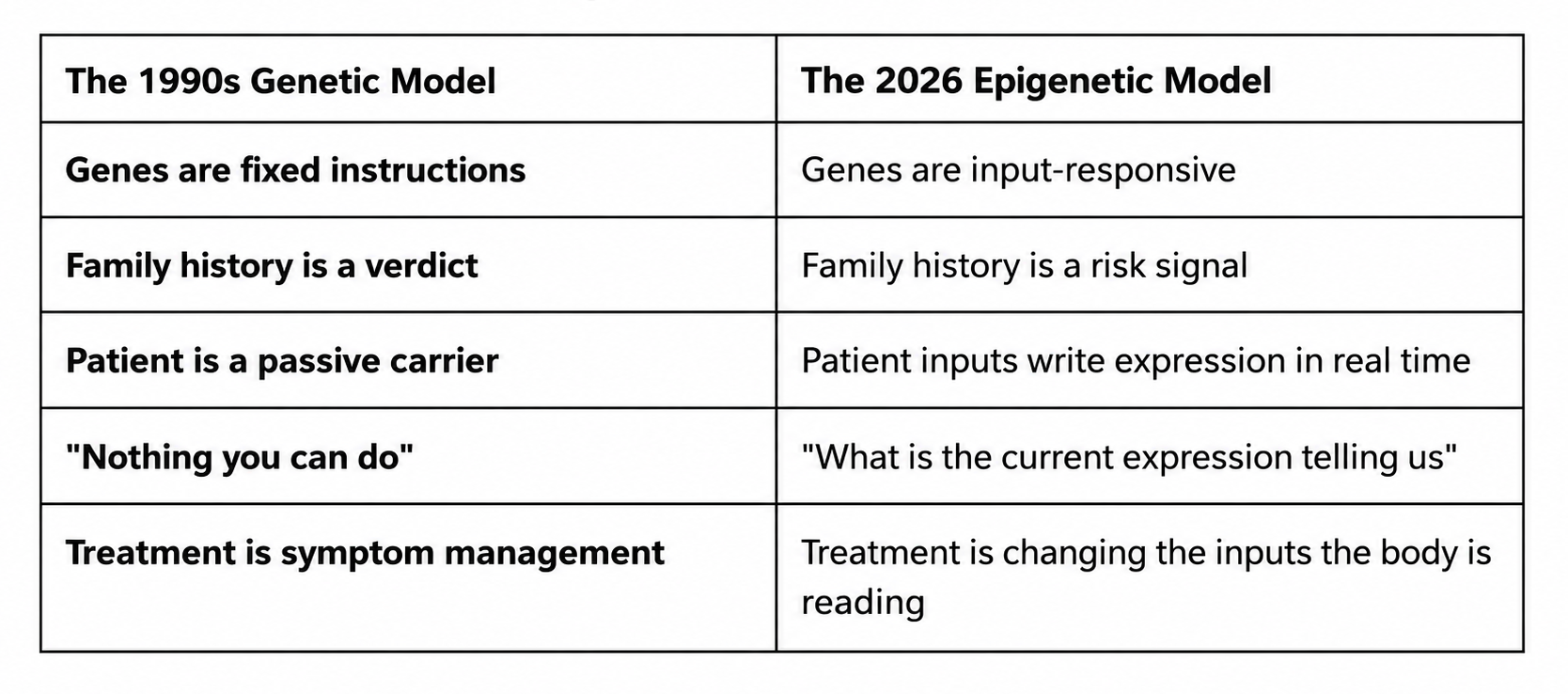
How to Read "It Runs in Your Family" Differently
The next time a clinician hands you "it is genetic" as the end of the conversation, hear it as the beginning. Family history just told them where to look. The workup they order next is the answer to whether they actually understood what they were told.
If you're sitting across from a provider who has just used your family history to close the door, ask one question: "What in my current physiology is the expression of that risk, and how would we measure it?" If they answer with a marker, a panel, or a specific input pathway, they're doing the work. If they answer with "let's keep an eye on it" or "we'll treat it if it shows up," you have a clinician who is using a 30-year-old model.
The pattern that signals you're inside an epigenetic conversation nobody is having: family history of metabolic disease, autoimmunity, hormonal decline, or cardiovascular pattern, layered on top of your own currently degraded performance, currently unmeasured inflammation, currently unread cortisol curve, and currently undiagnosed metabolic drift. That stack is not "it's genetic." That stack is your inputs and your inheritance in a conversation, and nobody has read the transcript.
THIS WEEK
Pull your most recent labs. Find every marker that came back "within range."
For each one, ask yourself a single question: do I know what input in my life is currently driving that number up or down?
If you can't answer for more than half of them, you don't have a genetic ceiling. You have a data gap.
The Conversation Your Workup Has Not Had Yet
If your family history has been used to explain why you feel the way you feel, but nobody has actually mapped what your current inputs are writing into your expression, that's the conversation that has not happened yet. The Performance Gap Diagnostic is where it starts.
Key Takeaways
•Family history is a risk signal, not a diagnosis. A clinician who treats it as a verdict is using a model that predates the field of epigenetics.
•Your gene expression is being rewritten in real time by nutrition, recovery, inflammatory tone, and environmental load. Those inputs are measurable and modifiable.
•The right question after "it runs in your family" is not "what did I inherit." It is "what is my current physiology expressing, and how would we measure it."