
The Diet Industry Has Been Selling You the Wrong Problem
You weren't doing it wrong. You were solving the wrong problem.
THE PROTOCOL YOU RAN
Your metabolism isn't slow. It's defending itself.
Not because you were doing it wrong. Because the protocol assumed a slow metabolism. You don't have one.
Those aren't the same problem. Treating them as the same problem is why the protocols keep failing. And the industry built around those protocols has no incentive to tell you the difference.
SLOW VS. DEFENDED: WHY IT MATTERS
A slow metabolism implies a system running below capacity for no particular reason. A defended metabolism is a system running a deliberate adaptive strategy in response to a perceived threat environment. The intervention that helps one actively worsens the other. That's not a nuance. That's the entire clinical picture.
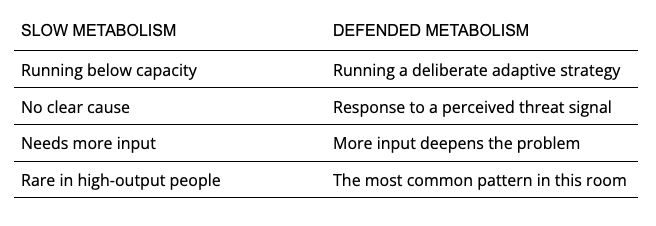
When the body is under sustained metabolic stress, chronic HPA activation, poor sleep architecture, glycemic instability, accumulated allostatic load, it makes a physiologically rational decision: reduce non-essential energy expenditure and protect core functions. Metabolic rate decreases. Fat oxidation shifts downward. The system prioritizes fuel conservation over fuel burning. This isn't malfunction. It's the body doing exactly what it was designed to do when it reads a threat signal.
The problem is that the body can't distinguish between an actual threat and the physiological signature of a high-output life. Sustained cortisol elevation reads as threat. Compressed sleep reads as threat. Caloric restriction layered onto a high training load reads as threat. The body responds to the signal, not the intention behind it.
The body responds to the signal, not the intention behind it.
This is where restriction fails for this population. Cutting calories in a system that's already in conservation mode deepens the threat signal. The metabolism adapts further downward. You eat less, the body burns less, body composition doesn't shift, frustration compounds. The protocol assumed a slow system. The actual situation was a defended one. The intervention made it more defended. This cycle is the repeat customer. And a repeat customer is a profitable business model.
Mitochondrial function is the variable that almost never gets assessed in standard or protocol-driven care. Mitochondria are the cellular machinery responsible for energy production. When mitochondrial efficiency drops, from oxidative stress, nutrient cofactor depletion, or accumulated metabolic load, output drops across every system simultaneously: energy, recovery, cognitive performance, body composition. You can't fix mitochondrial inefficiency with a caloric strategy. You can't even see it without the right functional test.
WHAT TO DO THIS WEEK
Three patterns that point toward metabolic compensation rather than a simple caloric equation problem:
Consistent deficit, no meaningful shift in body composition. Or losing and regaining the same weight in a short cycle. The body is matching its output to its perceived input. That's conservation adaptation, not a willpower problem.
Morning energy low that doesn't reliably improve regardless of sleep quantity. Not a bad night. A baseline morning low. This reflects a blunted morning cortisol peak failing to drive the metabolic activation the day requires. It's a cortisol rhythm problem showing up as an energy problem.
Training volume increased, body composition worsened or held flat. More training in a defended metabolic state adds to the threat signal. The body interprets additional training demand as confirmation that resources need to be rationed, not released.
The functional assessment that answers the actual question looks at glycemic variability across the day, not just fasting glucose. It maps inflammatory load. It traces the cortisol rhythm, because cortisol dysregulation is metabolically expensive in ways that show up in body composition before standard markers move. And it assesses mitochondrial function, because no caloric or training strategy produces the expected result when the cellular machinery generating energy is running below capacity.
THIS WEEK: Stop counting calories. Eat to satiety with adequate protein at every meal. Track your morning energy on a 1 to 10 scale, at the same time each day.
This is not the prescription. It's the diagnostic. What changes in seven days tells you which problem you've actually been solving.
THE BOTTOM LINE
A defended metabolism doesn't need more restriction. It doesn't need a better protocol. It needs the threat signal identified and removed.
That's a clinical question. If you've run the protocols and the results don't match the promise, you weren't doing it wrong. You were solving the wrong problem.
KEY TAKEAWAYS
A slow metabolism and a defended metabolism are not the same problem. The intervention that helps one actively worsens the other.
Caloric restriction layered onto a high-output, high-stress system deepens the threat signal. The body adapts further down. You eat less, it burns less.
Eating less sends the signal louder. The protocol keeps failing because it's solving the wrong problem, not because your discipline is lacking.